
Lessons from Chatt Fab Institute 2026
by Ben McIver, MakerUSA Program Manager
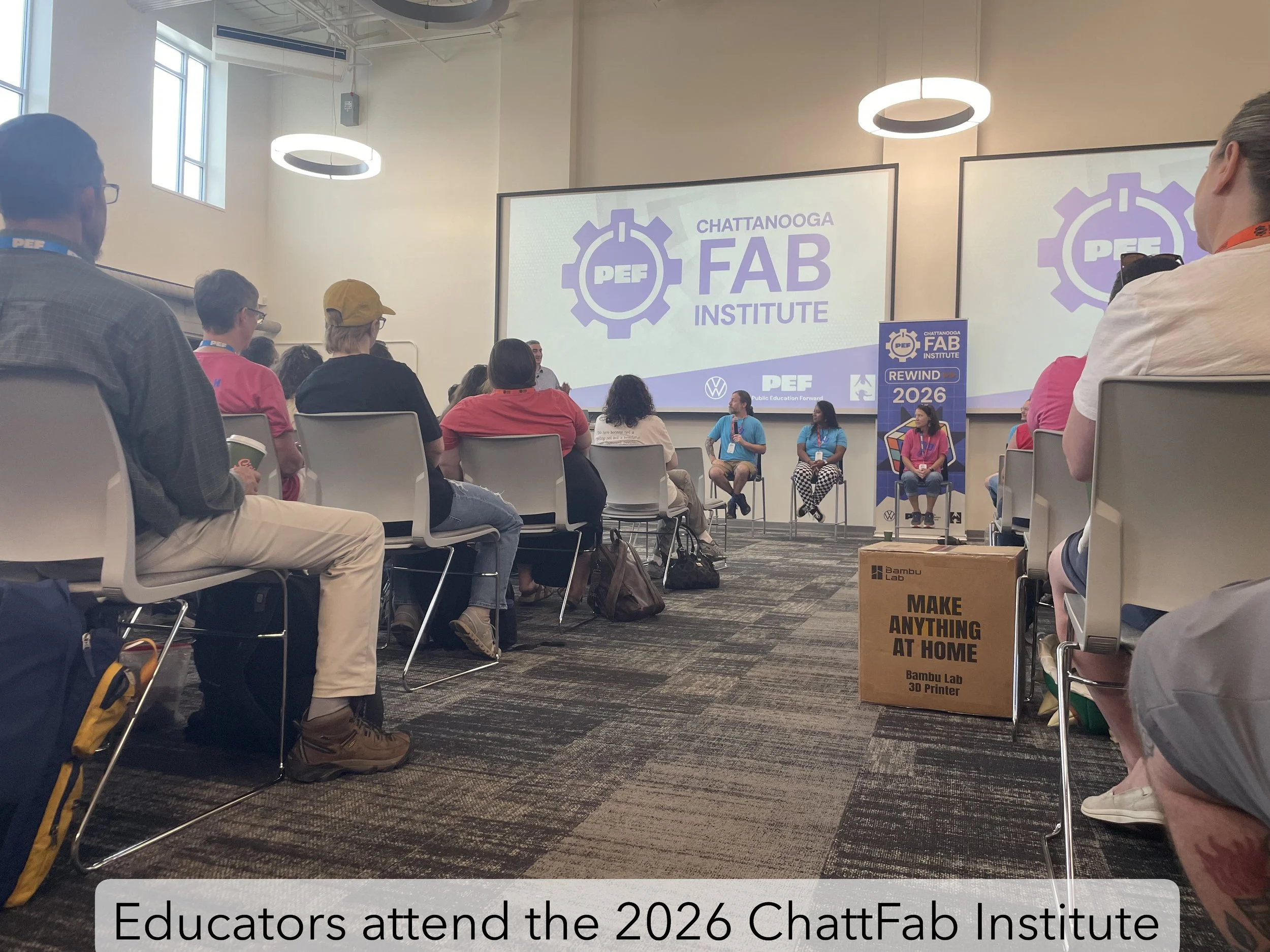
What am I doing here? What life decisions did I make to put me here? These were my honest thoughts as I rode on a yellow school bus for the first time in almost 40 years with a bunch of educators. High school, elementary, and the saints of the bunch middle school teachers. Now usually when someone usually utters those words to themselves it is in the derogatory sense. Right now for me it was a from a place of wonder, curiosity, and a little intimidation. See I am not an educator, and never in my conscious life plan did see myself in front of a group of kids day after day shaping their malleable minds, making them into good contributors to society. Even though I still don’t think that is my place, I do know that whatever energy and creativity I have left to dedicate to a career, I want to leave a mark and help inspire those who are going to be responsible for this world long after I leave it. So this was the right place.
So, for those unfamiliar with Chatt Fab and why this middle-age-ish (late middle age-ish) man is squeezing his 6ft 4inch frame into a hot, school bench seat designed for an 11 year old, let me catch you up. Chatt Fab is an annual convening of educators in Chattanooga Tennessee. It is sponsored by Volkswagen, who has a large manufacturing plant in Chattanooga, and is a natural extension of a grant they first issued in 2009 for the Hamilton County School System funding “innovation labs” in the school system. Since then, 43 innovation labs have been opened up in elementary, middle, and high schools throughout the Chattanooga area – maker spaces with 3D printers, electronic labs, laser cutters, wood shops, sewing machines, etc. These are spaces where students have the tools and supplies to make anything that they imagine. Chatt Fab gives those educators who have never used the labs for their classrooms, and those Innovation lab teachers to get together and exchange ideas and gain new skills.
As an operations manager for STE(A)M Truck and a Program Manager for MakerUSA this was something that was right up my alley and sorely needed. So, I registered, made my travel arrangements, and headed up the road from Atlanta. I was looking online for the schedule, to see what workshops I wanted to attend, which speakers I wanted to hear. Were their going to be vendors there displaying the newest gadgets? But there was nothing. Even after my arrival and attending the opening session with no posted schedule I was clueless. Then we were divided up into groups and put onto yellow school buses that whisked us off to different schools throughout the district.
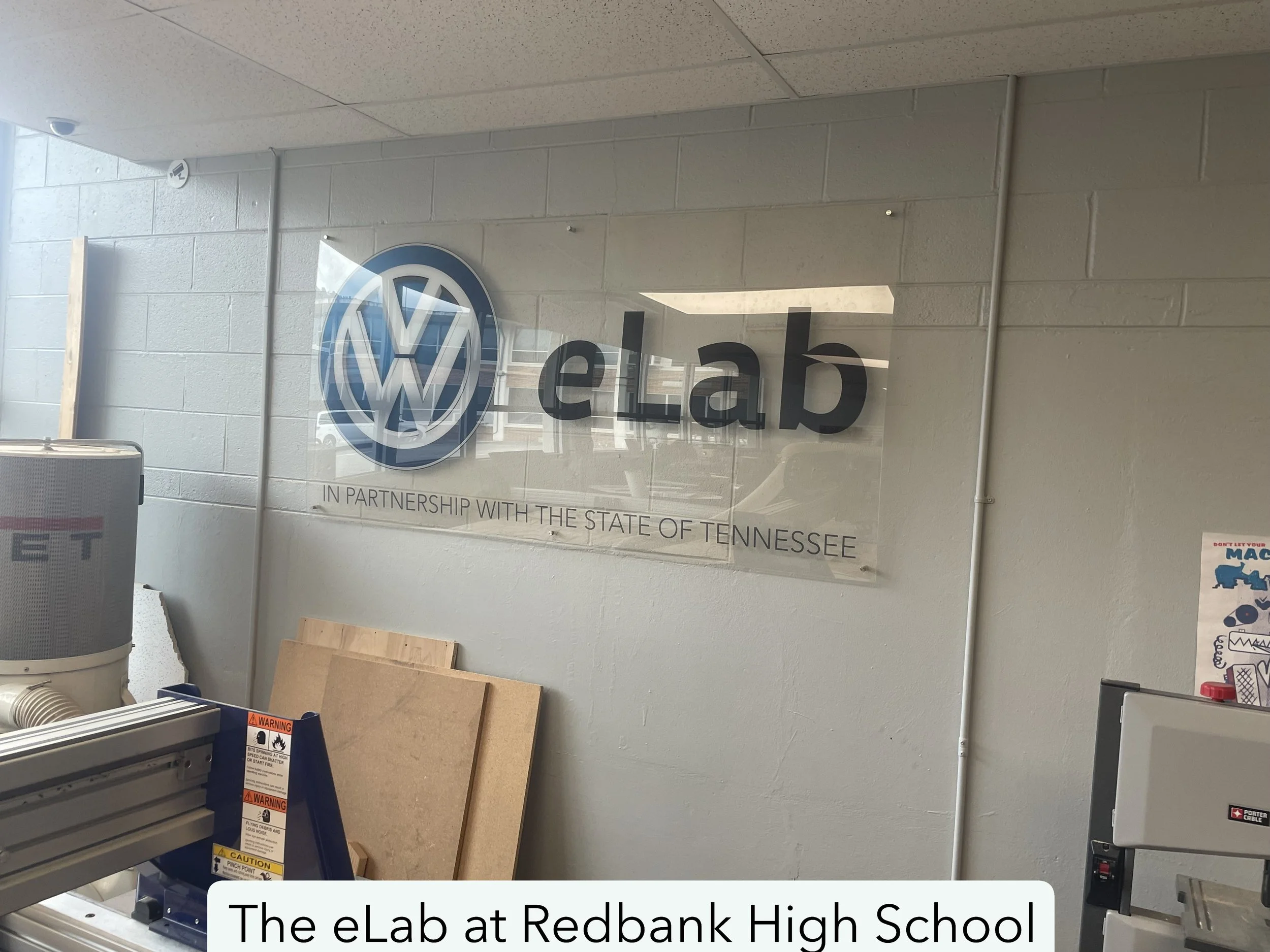
Well, 10 minutes after arriving at the Innovation Lab at Red Bank High School I found out what the very simple schedule was when Matthew Craig, the ELab Specialist at Red Bank, stood in front of the group spread out at the work tables and said “Alright, your task for the next 3 days is to recreate your favorite childhood toy with a modern update. Now go.”
WHAT????
I need you to tell me what to do. I need you to teach me how to do… (fill in the blank). I need mastery of at-least a few of these tools before I undertake such a project. NOPE. I wasn’t going to get that.
And then I realized that the whole point was “You don’t get the skills so that you can make. You make so that you can get the skills.” That making process trial and (most importantly) failure to see what really works and what is missing. And the making process includes collaboration and communication with others – essential skills that are much more that knowing math processes or the correct way to model and 3D print an object. And there was an openness to constantly learn and improve.
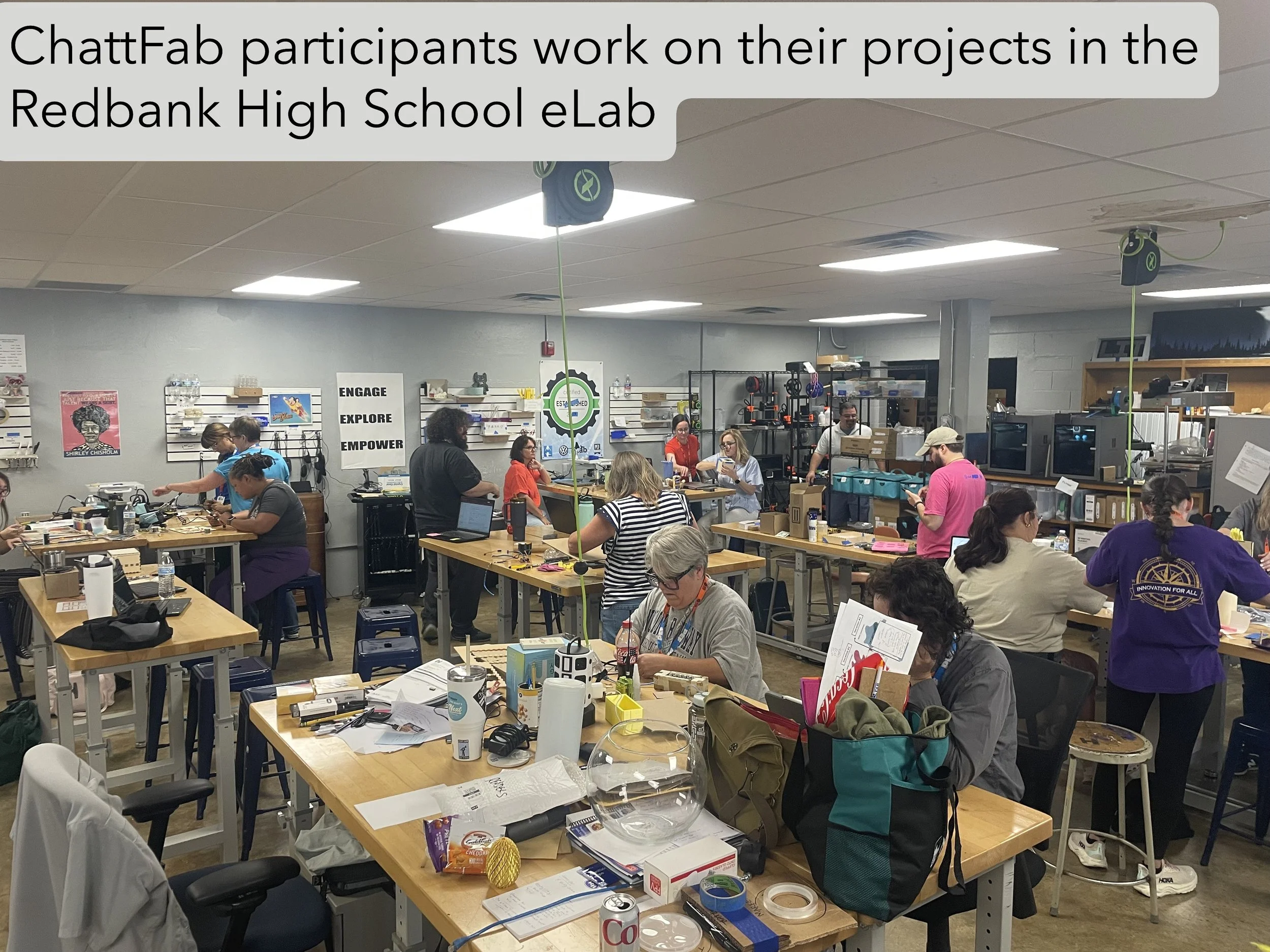
And from the start there was a lot of that going on. There were veterans of Chatt Fab that knew exactly what to expect and immediately put their pre-mediated plan in action. There were those like me who had some experience with maker spaces, knew how to use some of the tools but had some spoon-feeding expectation. And then there were those who never saw a 3D printer in person, didn’t know laser cutters existed, and had a deer-in-the headlights look.
But also, from the very start there was collaboration. ELab veterans helping newbies work out their ideas, not from a position of expertise, but as true collaborators – working out the best ways to bring their ideas to life, sharing what has worked for them in the past and they themselves admitting the limits to their knowledge but willingness to try new things and accepting the fact that it may fail.
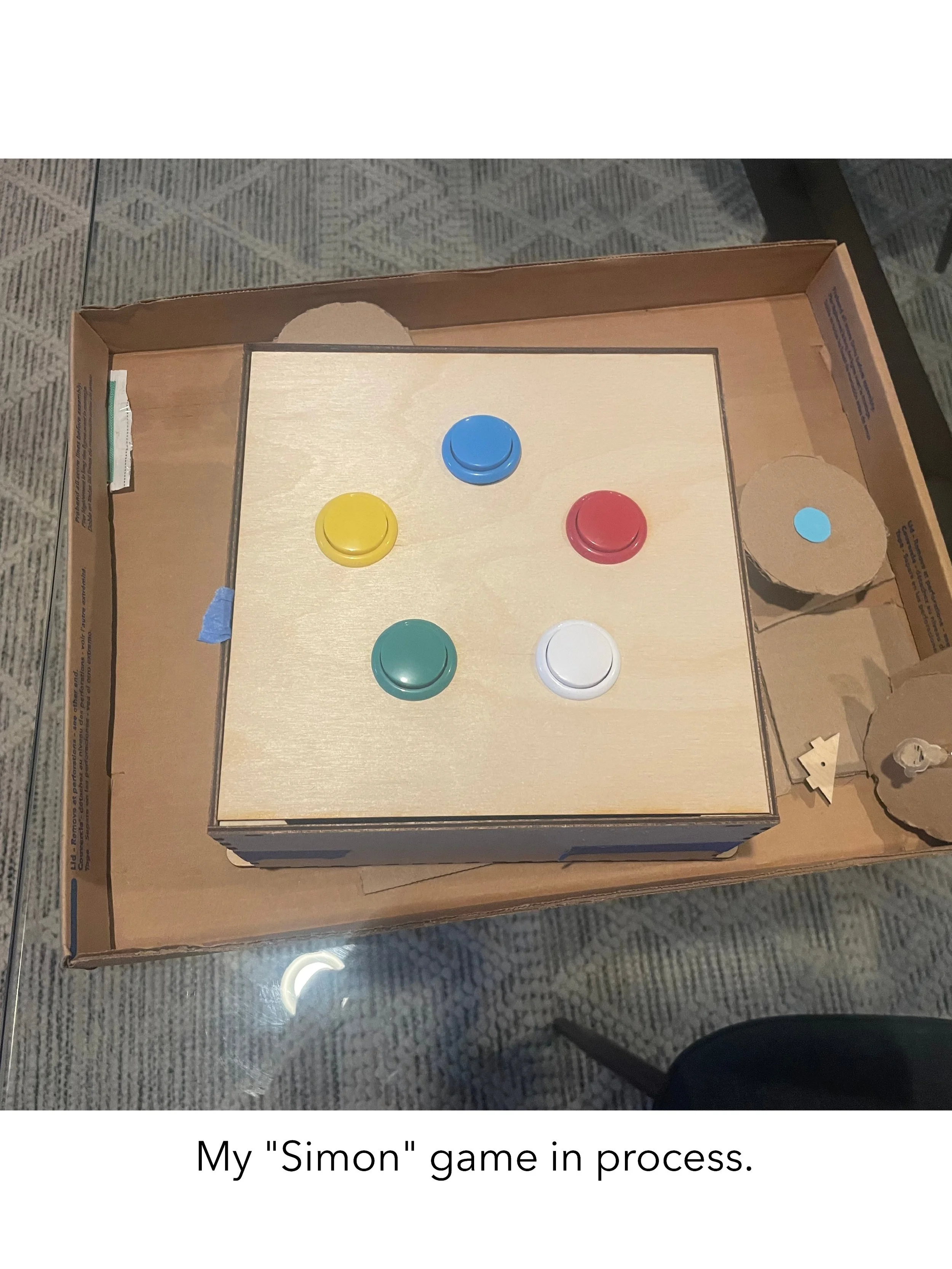
I got to work making an updated version of the electronic Simon Says game that instead of just colors and tones the buttons would be attached to 5 Chladni Plates that would create the sound wave patterns if the player hit the pattern correctly. Great idea!!! But I quickly realized the huge gaps in my knowledge. I was fairly confident I could design a build the physical parts of the game. But then I would have to figure out how to wire the switches so they would activate the lights, tones, and plates. I would then have to program “something” that would generate a random pattern for the user to repeat. That pattern would have to get incrementally more complicated and faster after each round. And I would have to figure out how to program that “something’s” response when the user got it wrong. AND on top of that, how do I build a Chladni Plate from scratch and should they reset themselves after each round? How would they reset themselves after each round?
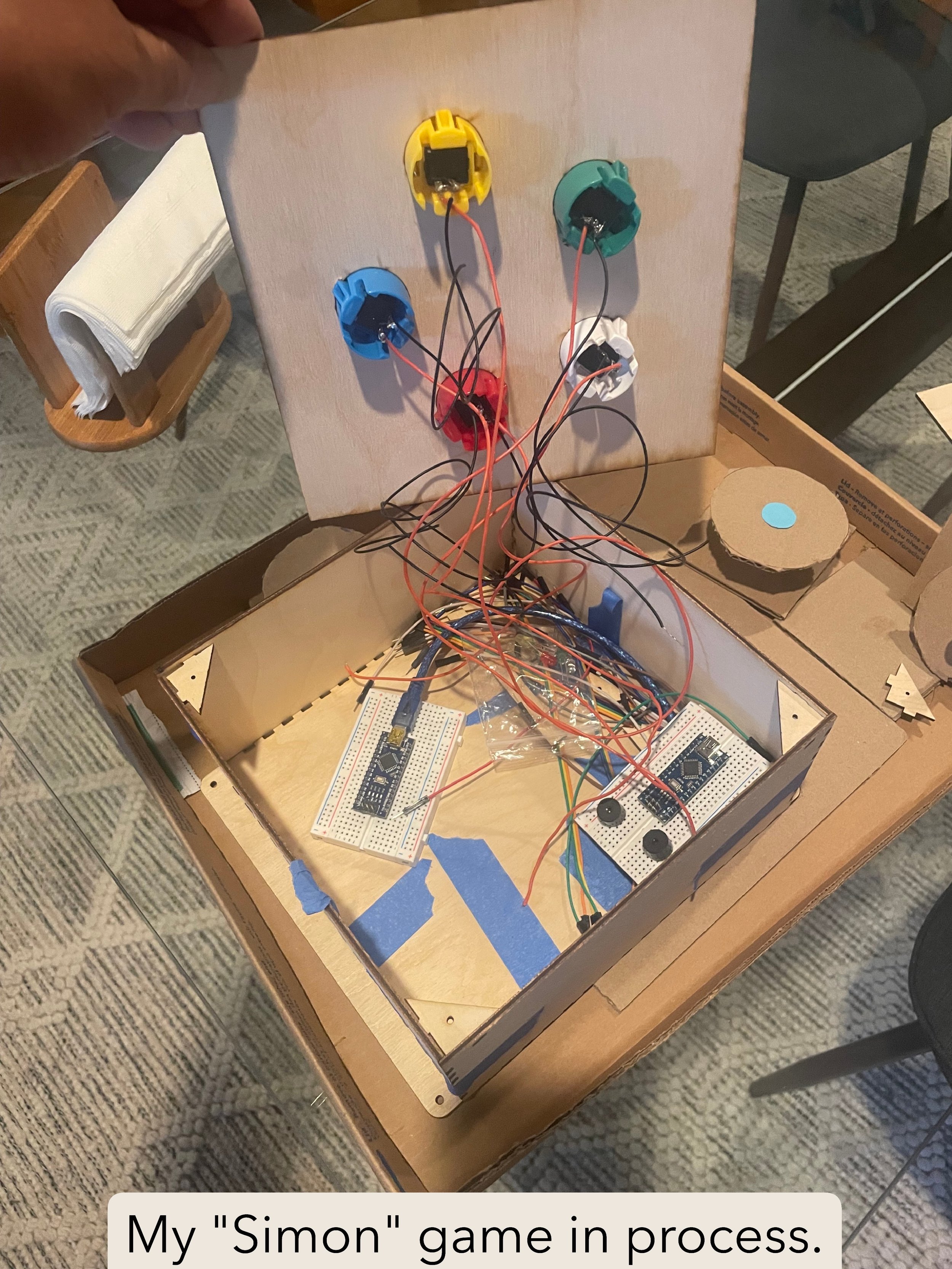
All this was the point of Chatt Fab, and the philosophy of pedagogy that they are embracing. What’s your idea? Alright, how can you make it a reality? What do you need to learn to make it a reality? Do it. Fail. See what worked. See what didn’t. Ask for help. Fail. Try again given what you learned. Constantly learn. Constantly improve.
Given the challenge that my imagination created and the level of experience with the tools I would need to build it, I knew that my game would not be completed in the 2.5 days of Chatt Fab. But the process was what was ultimately the most important. And as a maker educator it is the process that we need to commit to and therefore model and replicate in every one of the students that we come in contact with.
On the opening session of the 2nd day of the conference Michael presented a familiar diagram to the group illustrating the three legged stool of education - academics, technical skills, and essential skills. Academics being defined as the learning of wrote facts – mathematics, reading, history etc. Technical skills – the ability to use tools, play musical instruments, art, and athletics. And Essential skills – communication, collaboration, leading and working with a team.
For a multitude of reasons, we all know that for at least the last three decades the American educational systems have heavily skewed towards the Academic leg of the stool. Our over reliance on standardized testing, metrics that are quantifiable, to determine the quality of education each student receives and the success of the system overall has been at the explicit expense of independent thinking and imagination. The ability to synthesize facts with technical skills to work with others to find solutions to problems within ourselves and our communities is crucial to anyone’s education.
I only have to look at my own education as an example. I was by all quantifiable measures an extremely good student – (90th percentile in all categories). However, any sense of independent thought and creativity came from home. My parents pushed music education, dragged me to concerts “boring” lectures of political and cultural leaders at the local university. Even with all that intervention when I went of to college I still struggled with the attitude of “tell me what I need to know to pass the test” and “tell me what the exact steps that I need to do to be successful”.
In The 2025 Future of Jobs Report, the World Economic Forum polled over 1,000 leading global employers in 22 diverse industries to find out what skills they are looking for in employees. As you would expect knowledge and skill using AI was ranked highest in core skills needed by 2030. However not far behind that was Creative Thinking, Resilience, Flexibility and Agility, Curiosity and Lifelong Learning, and Analytical Thinking – all basic tenants of maker education. Knowing how to just use the tool will not be enough. However, what’s most important is how you apply it to solve problems, how you deal with “failures”, and when you succeed, how you make it better in the next iteration.
In this current environment, out challenge is to clearly define what maker education is and its extreme importance in the development of the next generation. It’s not vocational or technical. It is all those things but it is “other”. It is the ability to identify a problem, assess your current situation and the hurdles between you and the goal, and the confidence to utilize all of your resources (factual knowledge, tools, and people) to reach the solution. Then once you have arrived at your goal. see how you can improve. That general attitude towards education is essential for the next generation to be able to take on the existential problems that we face including the environment, economic disparities, and social issues.
